Showing posts with label EVOLUTION. Show all posts

Tuesday, May 18, 2010

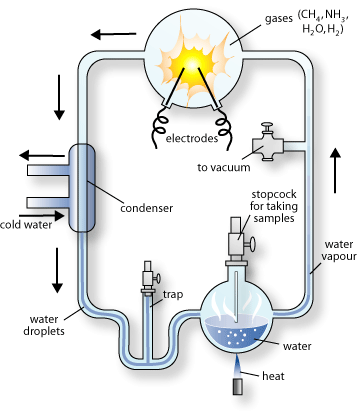
A Marine Chemist Studies How Life Began (article)

CLICK HERE to read an interview on how life began.
1. Amino acids have been found inside some of the meteorites that have come to earth, What does this indicate?

Monday, May 10, 2010

GENETIC VARIATION and EVOLUTION

CLICK HERE to read about how the lack of genetic variation in Irish potatoes contributed to the severity of the Irish potato famine.
1. Why are populations with low genetic variation more vulnerable to changing environmental conditions than diverse populations?
2. What are the sources of genetic variation?
3. Why is there little or no genetic variation in the the “lumper” potato variety?
4. Why does planting genetically uniform crops increase the risk of “losing it all” when environmental variables change?

Saturday, May 8, 2010

INTERACTIVE TREE OF LIFE

Explore the connections in the natural world, and learn about evolution with this Interactive Tree of Life.
1. Can you describe primitive life?
2. What organisms did you read about?
3. Is a Koala related to a Iguana?

CLICK HERE
to watch the Tree of Life video we watched in class.

Thursday, May 6, 2010

TREE OF LIFE

CLICK HERE to test your skills at judging who is who on the tree of life. The animation will show you different organisms and you will be able to construct different trees of life according to evolutionary relationships between the different organisms.
1. What type of evolution describes the acquisition of the same biological trait in unrelated species? Can you think of some examples?

Monday, May 3, 2010

EVOLUTION: 2 articles

1. BACTERIA RUN WILD, DEFYING ANTIBIOTICS Source NY Times
A new chapter in the continuing story of antibiotic resistance is being written in doctors' offices across the country

2. HUMAN CULTURE, AN EVOLUTIONARY FORCE. Source NY Times
Genes enabling lactose tolerance, which probably resulted in more surviving offspring, were detected in cultures like the Kenyan shepherd's

QUESTIONS:
1. How do these articles relate to the Living Environment curriculum?
2. (article 1) Why can the new resistant staph be treated with several common antibiotics different from the ones doctors are accustomed to using?

Saturday, May 1, 2010

NATURAL SELECTION

CLICK HERE to view an animation that shows how natural selection forces evolution of the finches population on a small island in the Galapagos. You will be asked to interact with the animation at the end. And you can take a 2 question quiz after watching the animation.
How did you do?
How does speciation occur?

CLICK HERE to view an animation that witness how the pollenpeeper (fictional organisms) evolve due to natural selection and adaptive radiation.

Thursday, April 29, 2010

EVOLUTION VIDEOS

CLICK HERE to access the website with the evolution videos we saw in class.
1. Which video clip do you find the most interesting? why?
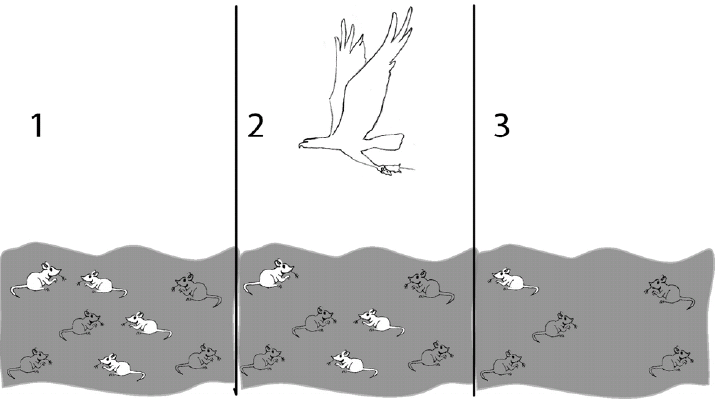
2. How does the picture relate to Natural Selection?
3. Why do characteristics that help an animal to live longer will become more common in the population?

Wednesday, April 28, 2010

COMPARATIVE EMBRYOLOGY: video clip from class

CLICK HERE to watch the video clip that shows the embryological development of four different species.
1. How can the study of the embryos help show the relationships among animals with backbones?
2. What do shared embryological developments indicate?
3. What part of the video clip did you find the most interesting? why?

Monday, April 26, 2010

HETEROTROPH HYPOTHESIS Video clip from class

CLICK HERE to watch the video that explains how the first organic compounds originated on the Early Earth.
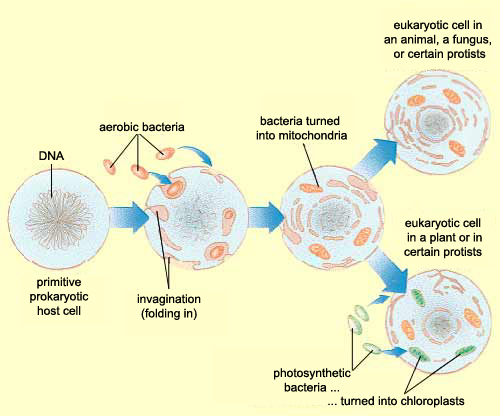
ENDOSYMBIOTIC THEORY

Click here to access a website with very good and helpful information on the Endosymbiotic theory.
What do you think?

Saturday, April 24, 2010

ENDOSYMBIOTIC THEORY

CLICK HERE to watch a narrated animation on the endosymbiotic theory. You can take a two question quiz after watching the animation. How did you do?
Look at the piucture on this post: What type of primitive eukaryote did the ancestral prokaryote in the diagram evolve into?